
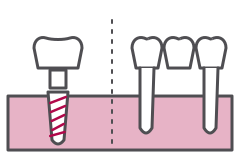
Implant or bridge: how to choose when replacing a tooth?
Replacing a missing tooth: implant, bridge or removable denture? Benefits, limits and how to choose, by Dr Le Moing, dentist in Noumea.
Read the article
An implant replaces the root of a missing tooth. It then carries a fixed crown that you brush like a natural tooth. Here is how implant treatment works at the practice.
Implants are suitable for most adults who are missing one or more teeth, provided there is enough jawbone and the gums are healthy. The initial assessment, with an X-ray and a 3D scan if needed, confirms this.
Some situations call for preparation or particular care: smoking, poorly controlled diabetes, untreated gum disease, certain medical treatments. These are discussed together during the consultation.
Good to know: an implant is brushed and cleaned with floss or an interdental brush, just like a natural tooth. Smoking increases the risk of failure: discussing it before treatment helps give the implant the best chance.
It generally takes a few months between placing the implant and fitting the final crown, while the bone heals. The exact timeline depends on your situation and is given to you at the assessment.
The procedure is done under local anaesthetic. Recovery is usually moderate: some swelling or discomfort for a few days, eased by the prescribed medication.
A well-maintained implant can last many years. How long it lasts depends mainly on daily oral hygiene, follow-up at the practice and not smoking.
The cost depends on the number of implants, the preparation needed and the restoration. A detailed estimate is given to you after the assessment. Coverage varies with your health insurance.
A bone graft or another solution, such as a bridge or a removable denture, can be considered. The assessment helps choose the most suitable option.
Replacing a missing tooth: implant, bridge or removable denture? Benefits, limits and how to choose, by Dr Le Moing, dentist in Noumea.
Read the article